What Is an ASN?
What is ASN?
If you’ve ever used an IP lookup tool or read a network report, you might have seen something called an “ASN.” This term often raises the question: what exactly is an ASN, and why does it matter for an IP address? In simple terms, an ASN is a key piece of the Internet’s behind-the-scenes machinery. In this article, we’ll explain Autonomous System Numbers in a way anyone can understand, while also providing insights appreciated by programmers and network enthusiasts.
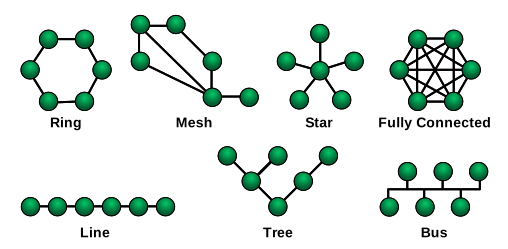
Key Takeaways
- ASN Definition: ASN stands for Autonomous System Number, a unique identifier assigned to a large network (called an Autonomous System) on the Internet. It’s like an ID number for an entire network or organization.
- Role in Internet Routing: ASNs are crucial for how the Internet routes data. They tell the global network which organization owns a group of IP addresses, helping routers decide where to send information. Think of it like area codes for networks – ensuring your data packets reach the right region of the Internet.
- Identifying Network Owners: By looking up an IP’s ASN, you can often find out which Internet Service Provider (ISP) or company is responsible for that IP range. For example, a lookup might show an IP belongs to ASN 15169 (which is Google’s network). This gives a clue about the IP’s owner in the Internet’s infrastructure.
- Technical but Limited Info: ASNs are mostly a technical detail. They don’t reveal personal information about users or exact locations – only the network operator. Understanding ASNs is useful for network troubleshooting and cybersecurity, but not necessary for everyday Internet use.
What is an Autonomous System (AS)?
To understand ASNs, we first need to understand Autonomous Systems (AS). An Autonomous System is essentially a large network or a group of networks on the Internet that is managed by a single organization or authority. Each AS controls a set of IP addresses and follows its own routing policies. For instance, your ISP (Internet Service Provider) operates an Autonomous System that includes all the IP addresses they assign to customers. Likewise, big tech companies, universities, and government agencies may run their own Autonomous Systems for their networks.
You can imagine an Autonomous System as a “network region” on the Internet – similar to a city in the real world. Just as a city has its own local roads and rules, an Autonomous System has its own internal routing and policies. However, that city (or AS) still needs to connect with others for the world to work as a whole. This is where ASNs come into play.
What is an ASN (Autonomous System Number)?
An Autonomous System Number (ASN) is the unique number assigned to each Autonomous System. It’s like the “serial number” or ID for that network region. The ASN is how other networks and routers identify an AS on the Internet. ASNs are usually written as “AS” followed by a number, for example, AS12345.
Originally, ASNs were defined as 16-bit numbers, meaning there were about 65,536 possible ASNs (0 to 65535). As the Internet grew, this wasn’t enough, so now we have 32-bit ASNs available, expanding the pool into the billions. In practice, only tens of thousands of ASNs are actively in use. Each ASN is globally unique – no two networks share the same ASN.
When an organization (like an ISP or company) needs to operate an independent network and exchange traffic with others, it can obtain an ASN from the regional internet authorities. There are five regional registries in charge of distributing ASNs (and IP addresses) to ensure each number is only used once worldwide. Examples include ARIN for North America, RIPE NCC for Europe, and APNIC for Asia-Pacific, among others. Getting an ASN usually means the organization has a significant network and multiple connections to the Internet (for instance, multiple upstream providers), which is why ASNs are commonly held by ISPs, large enterprises, and tech firms.
How Do ASNs Help Route Internet Traffic?
ASNs play a critical role in routing – the process of getting data from one point to another across the Internet. The Internet is often described as a “network of networks,” and ASNs are the codes that identify those individual networks. The routing protocol that coordinates this is called BGP (Border Gateway Protocol) – think of BGP as the traffic control system for the Internet, using ASNs as its route signs.
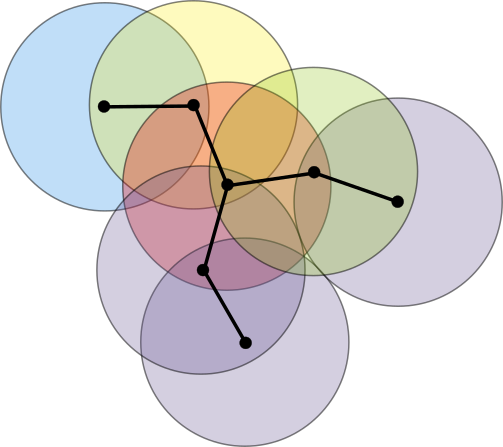
Here’s a simple analogy: imagine each Autonomous System (network) is like a town or region, and the ASN is like that region’s area code or postal code. When you send a letter in the mail, postal codes help route it to the right area before the local post office delivers it. Similarly, when your data travels across the Internet, it’s labeled with destination information that includes the ASN of the network it needs to reach. Routers use that ASN info to hand off the data from one network to the next until it arrives at the correct AS, where the final local delivery (to the specific IP address) happens.
For example, let’s say your computer in AS 11111 (Your ISP) wants to fetch data from a server in AS 22222 (Some Company’s Network). Your ISP’s network doesn’t directly know where that server is, but it knows (via BGP routing tables) that AS 22222 is reachable through a neighboring network. So your data packet might go from AS 11111 to AS 33333 (an intermediate backbone network), and then to AS 22222. Each handoff is guided by the ASN – like saying “send this to AS 22222.” This system prevents data from wandering aimlessly and ensures it takes an efficient path. In short, ASNs are vital for the Internet’s GPS, making sure traffic knows which road (network) to take next.
Why Should You Care About an IP’s ASN?
For many casual Internet users, knowing the ASN of an IP address isn’t crucial. You can browse, send emails, or watch videos without ever thinking about ASNs. However, there are some practical reasons and scenarios where ASN knowledge is useful:
- Identifying the Network Owner: An ASN tells you who is behind an IP address at the network level. If you use an IP lookup service, it might show something like “ASN 577 > Verizon Communications”. This means the IP address is part of Verizon’s network. This is useful if you want to know if an IP belongs to a big ISP, a cloud provider, a university, etc. For example, IPs from cloud data centers (like Amazon AWS or Google Cloud) will have ASNs associated with those companies, whereas a home user’s IP will show the ASN of a residential ISP in their region.
- Security and Abuse Tracking: For cybersecurity professionals or developers, ASNs can help in analyzing traffic. Suppose you see many IP addresses trying to access your service, and they all trace back to the same ASN (the same network provider) – that might indicate a coordinated source, or maybe a misconfigured network device. On the flip side, if you’re getting spam or attacks, knowing the ASN can help you understand if they’re coming from a particular hosting company known for such issues. Sometimes defenders choose to block or allow entire ASNs (i.e., entire networks) if they trust them or consider them risky, though this should be done with caution.
- Network Troubleshooting: If you have a technical background, ASNs can be handy for debugging routing problems. For instance, if a certain region of the Internet is unreachable, network engineers will check if a specific ASN (or group of ASNs) is having issues. Tools like traceroute will display AS numbers to show the path your connection is taking. Seeing where a connection stops can hint at which network in the chain is dropping the ball.
- Learning about the Internet’s Structure: Even out of curiosity, checking an IP’s ASN can teach you about how the Internet is structured. You might discover that a popular app’s servers are actually hosted in an unexpected country via a particular telecom provider’s ASN. It’s a reminder that the Internet isn’t a cloud in the sky – it’s a collection of physical networks with real organizations behind them.
In summary, while ASNs are not something you deal with directly, they add context. For a programmer or tech-savvy user, an ASN can reveal if a user’s IP is coming from, say, a known VPN provider’s network vs. a local ISP. This could influence how you handle that user in an application (for example, you might challenge a login coming from an unfamiliar ASN).
Common Misconceptions about ASNs
- “An ASN can pinpoint a person’s exact location or identity.” – Not true. An ASN typically corresponds to a large organization, not an individual. It might give a broad hint (for example, ASN belonging to an ISP in Sweden), but it won’t tell you the specific city or the person using the IP. It’s about who operates the network, not who the end user is. So, while ASN info might say “Vodafone Spain,” the actual user could be anywhere within Vodafone’s service area and remain anonymous in that sense.
- “Every IP address has a unique ASN.” – Not at all. Thousands or even millions of IP addresses can share the same ASN because they belong to the same network. For instance, all customers of a given ISP often fall under that ISP’s ASN. The ASN is like an umbrella for a whole IP range collection. Individual IPs are more like street addresses, whereas the ASN is the zip code for the whole neighborhood.
- “Only big ISPs or tech companies have ASNs.” – Generally, they’re the most common ASN holders, but not the only ones. Any organization that needs to manage its own routing can apply for an ASN. This includes universities, government departments, large enterprises, and sometimes even smaller companies that multi-home (connect to multiple providers) or participate in Internet Exchange Points. There are also private ASNs used internally that don’t appear on the public Internet. So, while you’ll often see well-known names (telcos, cable companies, cloud providers) in ASN lists, the range of ASN holders is diverse.
Limitations and Considerations of ASN Information
- Not a Geolocation Tool: As mentioned, an ASN by itself doesn’t give precise geolocation. At best, it might hint at a country or region if the network operates there. If you need to know where an IP is geographically, you’d use IP geolocation databases, not ASN alone. Often, many countries or a broad region can be under one ASN (especially for global cloud providers).
- Data Accuracy and Changes: ASN assignments can change over time. Networks merge, companies acquire others, or they might renumber their networks. Such changes are infrequent but possible. IP address blocks can also be moved from one ASN to another (for example, if a company changes upstream providers). Most IP lookup databases update this info regularly, but very recent changes might not reflect immediately. Always consider the possibility that ASN info could be outdated by a short period.
- Coarse Indicator for Risk: In security, some use ASN info as one factor for risk scoring (e.g., “this login comes from an ASN that is a known hosting provider, which might mean a proxy or bot”). This can be helpful, but it’s not foolproof. Legitimate users might come from “high risk” ASNs (like cloud or proxy networks) and malicious actors can appear on reputable ISPs. So, never block or trust something solely based on ASN — use it in combination with other data.
- Entire Network Implications: If you do choose to block traffic by ASN (some administrators do this to cut off entire hosting providers rife with bots), remember you’re affecting a vast range of IPs. This is a blunt instrument; for example, blocking one ASN could mean millions of users or servers can’t reach you, including innocent ones. Always double-check before taking such sweeping actions.
- No Personal Detail: It’s worth stressing that ASN doesn’t expose personal details. We mention this again because privacy is a common concern. ASN is public technical info. Knowing an IP’s ASN is like knowing which phone company owns a number – it doesn’t tell you who is making the call. So from a privacy standpoint, ASN data is not sensitive personal data, but rather infrastructure data.
Disclaimer
ASN information provided by IP tools is typically sourced from public routing registries and data feeds. While these are usually reliable, there’s no absolute guarantee of accuracy. If an IP lookup shows an ASN and organization name, consider it a helpful hint about the IP’s network, but not an official endorsement of the data’s correctness. If you need certified or up-to-the-minute info (for legal or professional reasons), you’d refer to an official WHOIS or IRR (Internet Routing Registry) record. For general use, however, the ASN info you get from most tools is perfectly adequate to understand the IP’s network context.
Conclusion
Autonomous System Numbers might sound like an esoteric topic, but they’re a fundamental part of how the Internet functions smoothly. In everyday life, you don’t need to worry about ASNs – your devices and apps handle all that automatically. However, knowing a bit about them gives you a peek under the hood of the Internet. It helps explain how data finds its way across countless independent networks worldwide. For developers, network engineers, or the curious-minded user, ASNs offer a way to identify the big players behind IP addresses and understand the Internet’s layout.
In a nutshell, an ASN is an ID for a network operator. It won’t tell you who you are interacting with online, but it will tell you which network your data is coming from or going through. That distinction is key in networking. Next time you perform an IP lookup and see the ASN info, you’ll know it’s pointing to the backbone of the Internet – the organizations and routers working behind the scenes to connect the world.